A Sense of Tumour

5,302 total blog hits

  • An unexpectedly bad year.

    It’s twelve months to the day since I underwent a brain biopsy confirming a brain tumour diagnosis. Six hours rendered unconscious whilst a tiny hole was drilled through my skull and then a very fine needle inserted, guided by a live MRI scan to take a small tissue sample for analysis. My anxious family waited patiently for news of my recovery. Our one year old daughter, frayed and fractious at spending six hours in one place with little entertainment, expertly watched over, distracted and amused by my loving wife, didn’t understand where I was. I can only imagine how my parents felt. An eventual visit to me in recovery, sedated with tubes and cables protruding from everywhere did nothing to calm anyone’s nerves.

    An extended stay in hospital was followed by the very hot days of summer 2018 which saw unimaginable pain, removal of surgical staples from my skull leaving a large scar (which still hurts even now), many steroids and painkillers, terrible weight gain, swollen legs, and chronic fatigue. It was all I could do to sit in the garden watching time pass.

    Conclusively, the medical team announced a few weeks later, it was multifocal pilocytic astrocytoma, wrapped around my brain stem intruding into the main control centre of my brain with risk of hydrocephalus. The tumour could break through into my brain stem meaning game over. Not usually seen in adults; a spectacularly rare condition. Three pathology laboratories had been consulted on the biopsy sample such was the unbelievable nature of my condition.

    But good news, it hadn’t presented anywhere else in my body so constituted a grade 1 primary tumour. Bad news, it’s location rendered it inoperable.

    And that was my membership card issued for a club to which no one wishes to belong.

    Life had already started swirling like a whirlwind almost a year prior to diagnosis; I already knew something with a great force was within me from the scans, bone marrow sample, spinal fluid lumbar puncture and the grave tone of the many doctors I visited. My GP consistently urged me to enjoy living in the present and to start a diary for my daughter.

    At work I’d been a corridor warrior bouncing from meeting to meeting with ideas and plans. I’d been a man of action as a senior figure in IT, responsible for the storage and security of millions of pounds of manufacturing research. Slowly the job had become a confusing mess, draining remaining brain power, my hands tied behind my back by an invisible force. A fog descended, shrouding small details and serious misjudgment lurked with increasingly valuable decisions. A huge effort was required just to make sure I didn’t mess everything up. The four hour round trip commute became a hazy, crazy and dangerous daze of a drive.

    I presented myself at the GP for a new patient screening just after moving house in the summer of 2017 with two unusual symptoms. The first was asymptomatic pain in my left cheek, which meant it was a bit numb. Secondly, we’d treated ourselves to an Indian takeaway that weekend and when going to collect it, I couldn’t for the life of me tell my wife where I was going. I finally stammered I was going to ‘the curry shop.’

    “Not to worry,” the GP reassured me, “it’s probably a trapped nerve but we’ll get you a scan to check.” Even an unerrupted wisdom tooth was cast under suspicion of causing trigeminal neuralgia.

    A month passed, hospital appointments were booked and promptly revoked amongst the you’re-just-not-sick-enough scheme instigated by then Health Secretary Jeremy Hunt. No matter, I thought, I’m a fully paid up member of private healthcare. Let’s get this sorted.

    I’ve always been a big supporter of the NHS. If you’re critically ill, there’s nowhere better to treat you than within the NHS. But I’d previously used private healthcare under a company scheme for a hernia repair and found the process painless, easy and a speedy four weeks where the NHS had spent a slow-footed four years to get to the same stage. I thought going privately could get the scans and tests done more quickly thus releasing resources in the NHS. Boom, everyone’s a winner, I’ll get a diagnosis and be back on the road in a jiffy.

    Except my private healthcare dropped me like a hot stone when a neurosurgical biopsy became the only way forward for a conclusive diagnosis. Someone needed to look at the tissue under a microscope to work out just what it was. Maybe you can get neurosurgery privately but they weren’t going to take a punt on me. I’ve nothing against my private healthcare provider. The risk of neurosurgery is so huge that immense critical care facilities are required to be on standby. Promptly tossed back over the fence into NHS territory, a team was assembled around me. Once the system swung into action, a date for the biopsy was proposed, although the day before it took place there was still some uncertainty as to whether there was a bed for me.

    The actual procedure is recounted in another post I’m still writing (I’ll put a link here when I’ve published it) but there was a lengthy delay in getting a diagnosis and the proposed reductive surgery was cancelled a week before the scheduled date. It was deemed just too risky. It was so serious that my preference for breathing unassisted for the rest of my life was actually taken into consideration.

    The rest of the summer and early autumn of 2018 seemed to meander until I was finally given a start date for fractionated radiotherapy. Photon beam linear accelerators would be used and I’d need to turn up every weekday for six weeks. Again, the actual process is covered elsewhere on the blog, but I mustered the strength where possible to collect my daughter with my wife from nursery after radiotherapy sessions, involving a twenty minute walk from the bus station. In hindsight it appears to have been highly beneficial to my recovery but at the time I remember begrudging the uphill trudge with my stick, weaving around the pavement and sometimes having to sit on a bench after ten minutes, my wife waiting patiently beside me.

    Radiotherapy concluded just before Christmas 2018 and we had a quiet Christmas and New Year. Family visited us as I was in poor condition and I don’t really remember much of it to be honest.

    Just before the year shuffled to an end, my wife organised a surprise get-together at our house with some of my oldest friends from school days. They came from all over planet Earth, taking time out from their busy schedules of seeing family when back in the UK, or travelling with their own young families from within the UK. I was genuinely touched and truly grateful to my wife for organising it and for my friends coming. I haven’t forgotten it and it came at just the right time. They were kind enough not to mention the dramatic hair loss.
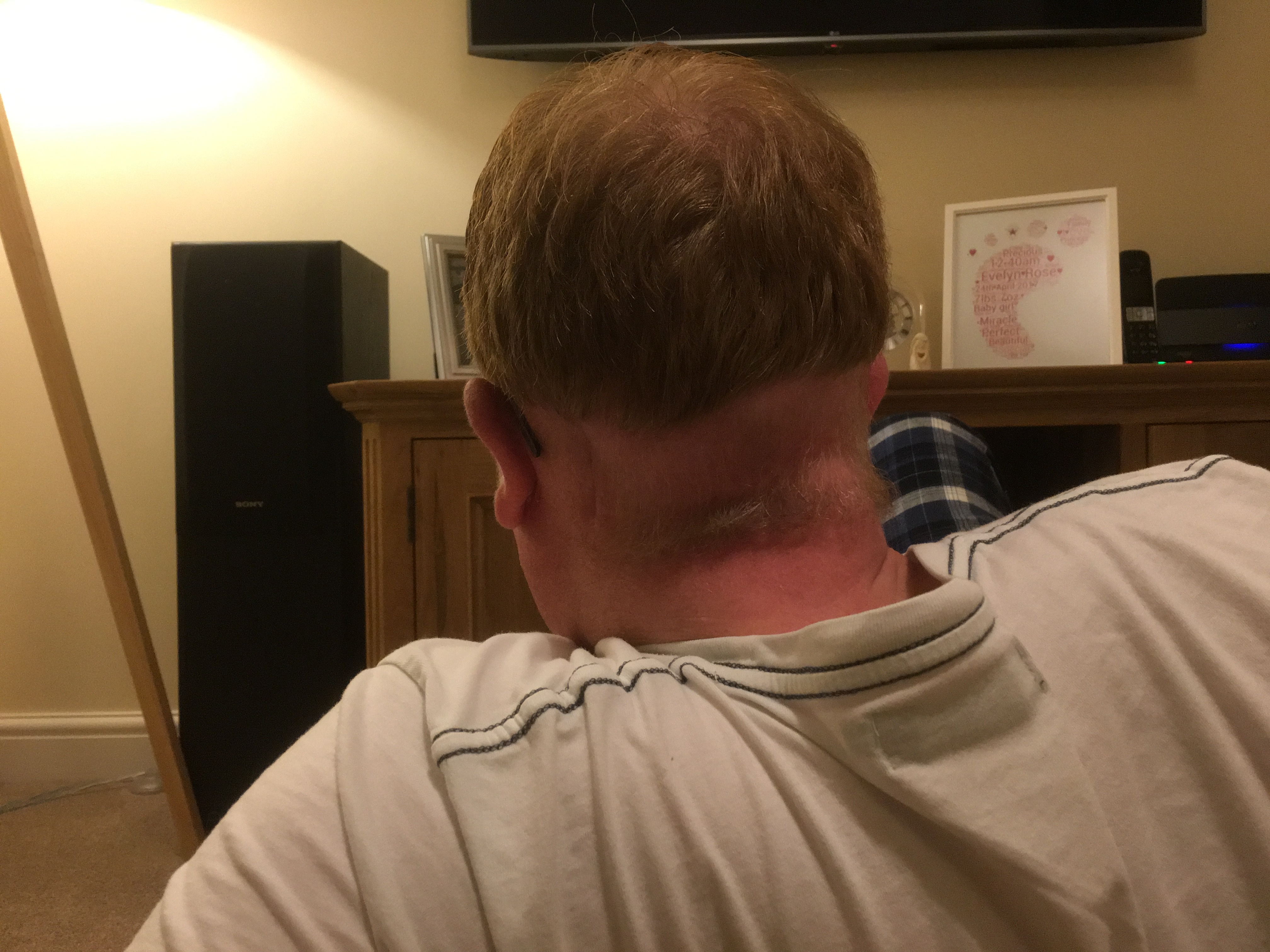
    Hair loss at the end of radiotherapy, November 2018. A selective haircut where the beam enters and exits.

    If you’re suffering from radiotherapy or chemotherapy side effects then I sincerely empathise. If you make a little time to catch up with some friends or family and forget your treatment for a few hours, I guarantee you’ll feel better for it.

    Other posts in the blog have more details about my treatment but it seemed fitting to write a bit of a summary for the 12 month anniversary of my biopsy. It’s something I hope to never have to repeat but if you’re about to undergo something similar, take heart that the experts don’t undertake such a procedure lightly, and you should get a definitive diagnosis. Treatment can be planned and it’ll remove some uncertainty from your life.
  • It’s 4am. It’s dark, quiet and I’m consuming biscuits at an undignified pace.

    It’s fairly standard procedure after a biopsy to control the swelling in your brain with steroids. In my case I was sent home with a truckload of dexamethasone and a blue medical card to carry with me at all times. The level of concern from the medical teams at discharge is carefully metered out in an attempt to keep you calm and dignified in the wake of someone drilling a hole in your head and threading a needle through your brain, trying to avoid the important bits. As it’s your brain, unfortunately all the bits are important.

    As the patient, I didn’t question the type, quantity or frequency of medication. You don’t in hospital do you? After all, the highly qualified and experienced doctors and nurses know best.

    Off I went home, clutching my bag of steroids like some terrible take-home kid’s party bag from a highly unusual weekender. Another prescription was being urgently generated between my local GP and pharmacy.

    I had an almighty hunger.

    Strange, I thought, considering I’d just had a major operation under general anaesthetic. Previous operation anaesthetics had left me feeling sick and unable to eat. Then I remembered I’d eaten everything I’d been given in hospital. I mean everything. Even the out-of-hours hot microwaved meals I’d been provided with by Sodexo, whom I presume won their PFI contract partly based on cost. M&S it certainly was not.

    At home I started consuming food at an alarming rate. I found myself pacing the kitchen tiles in anticipation of an online supermarket delivery, like a crack addict might wait on a street corner for their dealer to turn up. If it was my turn to do the shopping, the crates would arrive stacked with biscuits, chocolate, cakes and various puddings. In the evening at family dinner with my wife and daughter I’d have a pudding. Later, when my wife was on the final stretch of feeding our daughter to sleep, I’d have another pudding by myself. Daughter finally asleep, my wife would appear from upstairs tired and just wanting some quiet time, I’d gleefully ask if she’d like pudding. Sometimes she did. Even if she didn’t, I’d be crushing meringues into my face.

    We’d set up the spare room for me to recover in after the biopsy. Little did I know it would become a den for the overnight consumption of an extra couple of thousand calories a night. The steroids kept me awake to such an extent that some nights I just didn’t sleep at all. The summer of 2018 was incredibly hot in the UK, and contributed to night after night of sleepless restlessness, aided only by iced water and biscuits. It was like a craving. My brain wouldn’t stop badgering me until the chocolate digestives had been opened.

    Combined with the steroids, my size and weight ballooned so rapidly that the scars on my stomach from a repair operation a few years ago were suddenly stretched taut across a much bigger area. I’ve been left with stretch marks which I’m quite self conscious about.

    I’m on the road to recovery these days. My physiotherapist is helping me regain core muscle strength through a series of exercises and once I’m stronger I can do something a bit more athletic.

    I still love biscuits.

  • I apologise for the blunt delivery.

    I wrote this post on Facebook the day after my biopsy. It was the first time a lot of my friends knew something was happening. That’s not to say we weren’t in touch, but the lives of my friends were also busy and Facebook has become something everyone my age is using less and less. I’ve published it with a retrospective date and removed names. I hope it conveys how I felt at that time.


    So, some news. Like Jude Law in The Holiday, I apologise for the blunt delivery but yesterday I had brain surgery at Royal Stoke Hospital. I’ve not been well for months, I have multiple brain lesions of unknown grade and composition so the only way to confirm diagnosis is a biopsy of the tissue in my brain. It’s left me with a slight bleed on the brain, possibly causing hearing loss and requires a slightly extended stay in hospital. I’ve had so many scans and blood tests to rule out auto immune diseases and I had a trip to The Christie for a bone marrow sample to be taken.

    If you haven’t seen me for a while then please don’t be surprised to learn I now walk with a stick, have lost strength in the left hand side of my body and my conversation skills are problematic. You won’t always understand me and I certainly won’t always understand you. I can’t operate quickly enough to process incoming sensory information before it comes out again. I live with constant pain and numbness in my head, across my face, jaw and tongue. I nap for a few hours everyday, I wake up at the same time as the birds in the morning. The pain is unreal, like nothing I’ve ever experienced. I have double vision. I can’t taste food properly and sometimes can’t swallow. Obviously I’ve had to give up driving for now but I carried on as long as I was allowed. DVLA don’t like drivers having holes drilled in their heads so I have to prove in the coming months that I don’t experience fits or seizures. We have a double garage that we cleared out so at least my cars are in storage.

    I was signed off sick from my existing job during my notice period as I already had a new job to start. It took a long time for a potential diagnosis to be made (and I’m still waiting) and my new employer made all reasonable adjustments for me to commence employment. I have been treated with care, compassion and dignity by my line manager and HR department who are giving me space and time for treatment. It’s a great job with a lot of home working due to my support of multiple UK sites and it’s a very family-friendly employer which is so important with a one year old.

    I don’t know what the future holds. Neither does the medical profession so the advice is to spend as much time as possible doing what I can with my family at home. [My wife] is amazing, providing support and help whilst looking after our daughter. She’ll blush when I say this, but our love and marriage is a major source of strength and I thank my lucky stars every day that I have her. It’s hard being ill, but it’s also hard looking after someone who’s so ill and keep a one year old happy at the same time, especially when the one year old doesn’t yet know how to sleep through the night. [My wife] continues this day in and day out.

    My parents and [my wife]’s mum are helping out where they can and I’m extremely grateful for their support.

    Of course [my daughter] knows no different. She loves me just as much as she did yesterday and wants to play with me just as much as she ever did. I love our daughter so completely and every day I’m proud to be her daddy.

    I think a lot about the future. It’s a wake up call to discover you might not have as long on the planet as you hoped. Make sure you have insurance that pays incapacity benefit. Not to put too fine a point on it, I concentrated on life insurance which is no good if you simply can’t work. I remain hopeful this is a year long break in my career whilst I recover. Make a will with a proper solicitor, make sure it says what you want to happen. It’s a grim task that, once done properly, you can forget about.

    And what’s my overall advice? Make every day count and don’t do things that don’t satisfy you. I don’t believe in the mantra that everyone has a single purpose. Maybe you like doing lots of different things and that’s ok. As long as the bills are covered then try a few different things. Enjoy the time you have as I can guarantee that it’s finite; yours might be longer than mine. I’m not going to get all Life Advice here, just quietly go about making things happen.

    I’ll be at home quite a lot once I’m discharged from hospital until next spring so if you wanted to visit us you’d be welcome. There’s so much going on that it’ll be tea and cake (you bring the cake, make sure it’s a good one yeah?) It would take a bit of planning as we’re trying to keep things normal for [my daughter] as she goes to nursery three days a week and [my wife] is still working full time although she’s taking annual leave for a few weeks whilst we get a diagnosis and we know what treatment is proposed and make plans accordingly. I also get tired really quickly almost to the point of narcolepsy. But it would be nice to see you if you’re around.

    I wish everyone I know a long and happy life.

    Finally, always be kind. You might never really know what burden people are carrying.